How to Hire App Developers in India: A Founder's Guide
A practical guide for founders on hiring app developers in India. We cover real costs, vetting strategies, and contract must-haves to avoid common pitfalls.

By Prabhat Patra
Updated on Nov 15, 2026
Table of contents
What are the real costs to hire app developers in India?
The honest answer is it varies dramatically, from a few hundred dollars for a tiny freelance gig to tens of thousands for a dedicated team. For a standard business app with fixed scope, expect project-based pricing to be in the ₹2,00,000–₹3,00,000 range, while dedicated mid-level developers from a product studio can cost between $4,000 to $6,500 per month.
Stop thinking about cost in a vacuum. The price tag is tied to the hiring model you choose, and each has completely different trade-offs.
- Freelance Developers: You'll see hourly rates from $10 for a junior developer to over $80 for a specialist in AI or blockchain. A solid mid-level developer typically falls in the $20-$50/hr range. This model works for small, well-defined tasks, but managing them, ensuring quality, and piecing together a full product becomes your full-time job.
- Product Studios / Tech Partners: Here you're not just hiring a developer; you're hiring a small, managed team (dev, PM, QA). A dedicated developer from a studio can range from $2,500 to over $10,000 a month depending on experience. Alternatively, many offer fixed-scope pricing for an entire project. This is a strong option for building an MVP or V1.0.
- Full-Time In-House Hire: A mid-level developer's salary might be ₹1.5L–2.5L per month. But the 'fully loaded' cost is much higher once you factor in recruitment, benefits, equipment, and management overhead. This makes sense for your core, long-term product, but it's slow and expensive for getting a new idea off the ground.
Most teams get this wrong by only looking at the hourly rate. A cheaper developer who requires constant hand-holding and produces buggy code will cost you far more in the long run. For a deeper dive into project costs, our guide on mobile app development cost for startups in India breaks it down further.
Should I hire a freelancer, a product studio, or an in-house team?
A freelancer is best for a small, hyper-specific task, while an in-house team makes sense for your core, long-term product. A product studio (or tech partner) is the sweet spot for building a version 1.0 or a specific internal tool with a defined scope and timeline, giving you speed and expertise without the long-term commitment.
Think about what you're actually buying.
With a freelancer, you're buying hours. With an in-house team, you're buying long-term capacity. With a product studio, you're buying a specific outcome—a shipped product.
Here’s a simple breakdown:
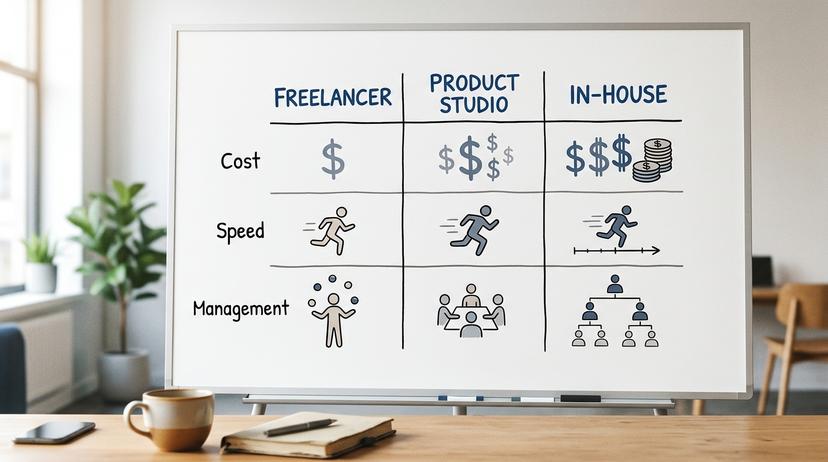
| Factor | Freelancer | Product Studio | In-House Team |
|---|---|---|---|
| Cost | Lowest initial outlay | Medium, predictable project cost | Highest, ongoing expense |
| Speed to Start | Fast (days) | Fast (1-2 weeks) | Slow (months) |
| Management | High (all on you) | Low (they have a PM) | High (you build the structure) |
| Ownership | You own the code | You own the code | You own the code |
| Best For | Small tasks, bug fixes | MVPs, V1 products, internal tools | Core, long-term products |
The studio model is often the most efficient for founders. You get the expertise of a full product team—devs, a project manager, and QA—from day one. This avoids the classic mistake of becoming a full-time project manager yourself instead of focusing on customers. If you're weighing these options for your first product, our guide on freelancer vs agency for an MVP can help you decide.
How do you evaluate a developer's portfolio and code quality?
Looking at a finished app in a portfolio isn't enough; you need to see how it was built. The best way to vet a team is to run a small, paid one- or two-week trial sprint to build a single feature, which lets you assess their code, communication, and speed firsthand.
A slick UI can hide a mountain of technical debt. A portfolio proves they can get an app into the App Store, but it tells you nothing about the maintainability of the code. Here's how to go deeper:
- Ask for a Code Walkthrough: Don't just ask for a GitHub link. Say, "Can you walk me through the code for a feature you're proud of? Why did you structure it this way?" You're testing for clarity of thought and communication.
- Run a Paid Trial Sprint: This is the single best thing you can do. Define a small, self-contained feature. Pay them for a fixed one-week sprint to build it. At the end, you'll know exactly how they work. Is the code clean? Did they ask smart questions? Did they deliver on time?
- Check for Process, Not Just Polish: Ask about their process. How do they handle testing? What's their approach to version control? How do they manage project scope? A professional team will have clear, confident answers. An amateur will get flustered.
We did this when building the Apexis Pro construction SaaS platform. The initial build was broken into clear, weekly releases. This process de-risked the project for the client and ensured the final product matched their operational needs, all within a fixed scope.
What interview questions should I ask a potential developer or team?
Focus on problem-solving and process, not just 'gotcha' syntax questions. Ask them to walk you through a past project's technical challenges or describe how they'd approach building a core feature of your app to see how they think.
Your goal isn't to find someone who has memorized every algorithm. It's to find a partner who can solve business problems with code. Try these:
Process & Collaboration Questions
- "Walk me through a time a project's scope changed significantly. How did you and your team handle it?"
- "You've been given a feature spec that you believe is vague or technically flawed. What are your next three steps?"
- "How do you prefer to receive feedback on your work? How do you give feedback to designers or product managers?"
Technical & Architectural Questions
- "Let's say we need to build a simple user registration and login feature. What technologies would you use for the front-end and back-end, and why?"
- "Describe the architecture of a recent app you built. What were the key trade-offs you made?"
- "How do you approach testing and quality assurance in your mobile app projects?"
One of our favorite tactics is to ask a slightly ambiguous question. A great developer will ask clarifying questions. A weak one will make assumptions and start building the wrong thing.
How can I protect my IP and avoid getting locked in?
Your contract must state unequivocally that you own 100% of the code, designs, and infrastructure accounts from day one. A trustworthy tech partner will give you full admin access to the GitHub repository and cloud accounts (like AWS or Vercel) so you're never held hostage.
This is a huge, legitimate fear for founders. You pay a fortune for an app, and then the developer disappears or holds your code ransom for more money. It happens. But it's 100% avoidable.
Here are the non-negotiables for your contract:
- Intellectual Property: A clause that says all work product, including source code, designs, and documentation, is your exclusive property upon payment. No ambiguity.
- Account Ownership: You should create the accounts (AWS, Google Play, Apple Developer), and grant the developer access. You should never let them create these accounts under their own name.
- Source Code Access: You should have admin access to the source code repository (e.g., GitHub, GitLab) from the very beginning.
This is standard practice for any professional product studio. At Rhinon Labs, for example, our contracts guarantee clients 100% ownership of everything we build. You get the keys to the kingdom because it's your kingdom. It addresses the fear of getting locked in by making it impossible from the start.
What's a realistic timeline for building a mobile app?
For a well-defined MVP, a focused build can take as little as 4-6 weeks, but a more feature-rich business application often lands in the 3-5 month range. Remember that your own team's feedback and approval speed is a major factor; a one-week delay in feedback can easily add a week to the final delivery.
Timelines are notoriously tricky, and anyone promising a complex app in two weeks is either lying or misunderstanding the scope. Based on market data and our own experience, here are some realistic benchmarks:
- Simple MVP (core feature, basic UI): 4-6 weeks
- Standard Business App (multiple features, integrations): 3-5 months
- Complex Platform (marketplaces, SaaS): 6-9+ months
The biggest variable isn't coding speed; it's scope clarity and decision speed. If you have your user flows, designs, and business logic locked down, a focused build can be incredibly fast. For some of our clients with a very tight scope, we've been able to deliver a V1 in just 2-4 weeks.
Break the project into weekly releases. This forces clarity and ensures you have a working piece of software in your hands every single week. For more on this, check out our guide on how long it takes to build an MVP in India.
Finding the Right Partner
Choosing the right build partner is about more than just code; it's about finding a product team that understands your business goals. You're not looking for a pair of hands; you're looking for a brain you can trust to make good decisions on your behalf.
If the product studio model sounds right for your V1, that's how we operate at Rhinon Labs. We're a tech partner for startups, building end-to-end mobile apps without the overhead of hiring an in-house team. We've built platforms like FurrCircle, a complete pet-parent app for web, iOS and Android, taking it from idea to launch. If you have an app you need to get built, let's talk about the scope.
Frequently Asked Questions
Frequently asked questions
The key is to establish a 2-3 hour overlap in your workdays for real-time collaboration and stand-ups. Use asynchronous communication tools like Slack and Notion for everything else, and insist on a daily or end-of-day summary email to stay aligned without needing constant meetings.
Most professional studios offer a warranty period (e.g., 30-90 days) to fix any bugs found after launch. After that, you can typically engage them on a monthly retainer for ongoing maintenance, updates, and minor feature additions. Make sure this is discussed before the project starts.
The biggest mistake is choosing a partner based solely on the lowest cost. This often leads to poor code quality, communication breakdowns, and a failed project that needs to be rebuilt, costing far more in the long run. Prioritize clear communication and a proven track record over the cheapest hourly rate.
Absolutely. India has a massive talent pool skilled in the most popular cross-platform frameworks like React Native and Flutter, as well as native development with Swift for iOS and Kotlin for Android. You will have no trouble finding teams proficient in modern, scalable technologies.
For freelancers, platforms like Upwork and Toptal are popular. For finding product studios or agencies, professional networks like LinkedIn and curated directories like Clutch or GoodFirms are better resources. However, direct referrals from other founders in your network are often the most reliable source.
Get an honest MVP assessment in 5 minutes.
We tell you what to build, what to skip, and what it'll actually cost. No fluff.
Assess My IdeaFree · 5 minutes · No obligation