MVP Development Cost in India (2027): A Founder's Guide
Planning your MVP? We break down the real MVP development cost in India for 2027, from hidden fees to team selection, so you can build without breaking the bank.

By Prabhat Patra
Updated on Oct 20, 2026

Table of contents
How Much Should an MVP Really Cost?
You have the idea, the deck, and maybe even some early interest. But the one question that stalls everything is: how much will it actually cost to build the first version? You've probably heard a dozen different numbers. The truth is, the MVP development cost in India typically ranges from ₹4 lakh to ₹25 lakh ($5,000 to $30,000). But that wide range is almost useless without context.
The real question isn't just about the final number on a quote. It's about what you get for that money, the hidden costs that can double your budget, and how to avoid building a product nobody uses. Getting this wrong means more than just wasted cash; it means lost time and a missed market opportunity.
The Three Tiers of MVP Costs (And What You Get)
An MVP isn't one-size-fits-all. The cost is directly tied to complexity. Based on our experience building operational tools, here’s a realistic breakdown of what you can expect at different budget levels.
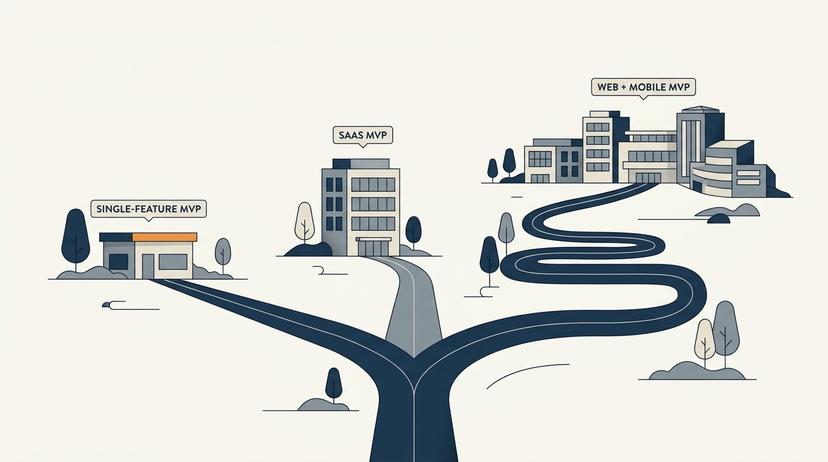
The Single-Feature MVP: ₹4 Lakh – ₹8 Lakh ($5k - $10k)
This is your starting point. It's a focused web application that does one thing exceptionally well. Think of a specialized calculator, a simple booking system, or a tool to automate one specific internal report. It usually involves one user type and a clean, simple interface. With a focused build process, a single-feature MVP like this takes 2–4 weeks at Rhinon Labs (industry average without a dedicated team runs 2–3 months).
The SaaS or Multi-Role MVP: ₹8 Lakh – ₹15 Lakh ($10k - $18k)
This is where most B2B ideas land. It’s a web application with multiple user roles (like 'Admin' and 'User'), a dashboard for analytics, and integrations with one or two third-party services (like a payment gateway or CRM). It solves a more complex workflow and requires more backend logic. With the right team, this tier typically ships in 3–6 weeks at Rhinon Labs (industry average is 4–5 months when built in-house or through a generalist agency).
The Web + Mobile MVP: ₹15 Lakh – ₹25 Lakh+ ($18k - $30k+)
This tier is for products that require both a web platform and a dedicated mobile app (iOS or Android). The complexity multiplies because you're managing different codebases, user experiences, and platform-specific features. This is a significant undertaking — typically 6–10 weeks at Rhinon Labs, versus 6+ months when built without a focused product team. Don't start here unless a mobile app is absolutely essential to your core user workflow.
Freelancer vs. Agency vs. Product Studio: A Quick Comparison
Who you hire has the biggest impact on your cost and your stress level. Choosing the cheapest option often costs more in the long run. Here’s a simple table to compare your options.
| Hiring Model | Typical Cost (INR) | Who Manages the Project? | Best For |
|---|---|---|---|
| Freelancers | ₹1.5 Lakh – ₹5 Lakh | You | Simple, single-feature projects where you can act as the project manager and QA. |
| Development Agency | ₹8 Lakh – ₹25 Lakh | Account/Project Manager | Complex projects needing a full team, but be wary of overhead and junior developers. |
| Product Studio | ₹4 Lakh – ₹12 Lakh | Senior Product Lead | Founders who need a strategic partner, not just coders. Focus is on speed and business outcomes. |
The Hidden Costs That Wreck Most MVP Budgets
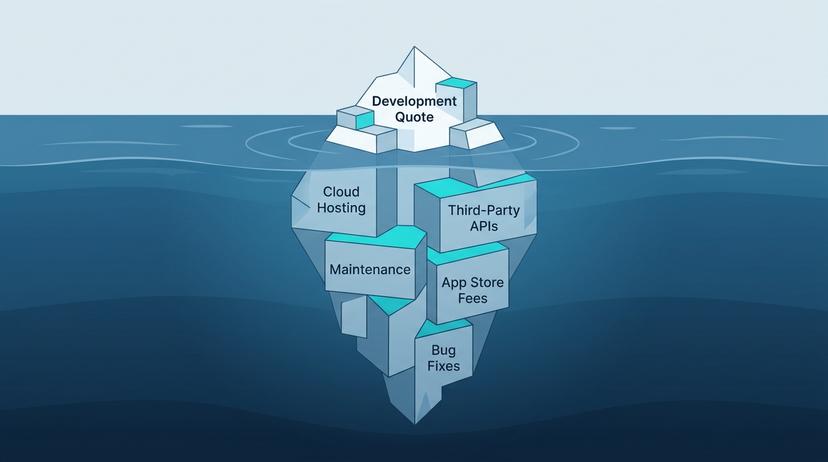
The number on the development quote is just the beginning. Most founders get blindsided by the ongoing operational costs required to simply keep the product online. Budget for these from day one.
- Cloud Hosting (AWS, GCP, Azure): Your code needs to live somewhere. Expect to pay $50 - $500 per month for initial infrastructure. This can scale quickly with user growth.
- Third-Party APIs: Does your app need to send SMS (Twilio), process payments (Stripe), or use AI (OpenAI)? These services charge based on usage and can range from $100 to over $1,000 per month.
- App Store Fees: If you're building a mobile app, you have to pay the gatekeepers. It’s $99 per year for the Apple Developer Program and a one-time $25 fee for the Google Play Store.
- Post-Launch Maintenance: This is the big one. Plan to spend 15-25% of your initial development cost annually on maintenance. This covers bug fixes, security patches, dependency updates, and minor tweaks. Without it, your product will slowly break.
The #1 Mistake: Building Your 5-Year Vision into Version One
The most common and expensive mistake is feature creep. It starts with “just one more thing” and ends with a delayed, over-budget product that tries to do everything and excels at nothing. We've seen founders burn through their entire runway trying to perfect an MVP that was never validated by a real user.
An MVP's purpose is to learn, not to be a perfect, finished product. Every feature you add increases complexity, introduces potential bugs, and pushes back your launch date. This is especially true for internal tools. Instead of building a massive system, focus on the one bottleneck that causes the most pain. Often, the problem isn't a lack of features, but a question of who actually owns ops in the first place.
A 4-Step Plan to Scope Your MVP and Get a Real Quote
To control your MVP development cost in India, you need to provide a clear scope. Don't just show up with an idea; show up with a plan. Here’s how a non-technical founder can do it.
Step 1: Define the One Core Workflow
Forget the feature list. Instead, map out the single most important journey a user will take. For an architecture firm's client portal, like the one we built for ApexisPro, the core workflow was: Client logs in -> Views project progress -> Approves a drawing. That's it. Everything else was secondary. What is your product's core workflow? Write it down in 3-5 steps.
Step 2: Prototype It (Without Code)
Before a single line of code is written, create a clickable prototype. Use tools like Figma, Balsamiq, or even just a set of slides. This forces you to think through the user experience and allows you to get feedback from potential customers for free. A prototype that costs a few hundred dollars to make can save you tens of thousands in development changes later.
Step 3: Write a Simple Scope Document
This doesn't need to be a 100-page technical document. Just a simple 2-3 page document outlining the core workflow, user stories for each step, and any key third-party integrations. This clarity is what allows a development team to give you an accurate, fixed-price quote.
Step 4: Ask for a Fixed Price (and What’s Excluded)
Avoid hourly billing if you can. It creates a conflict of interest where delays benefit the developer. Provide your scope document and ask for a fixed-price quote tied directly to that scope. Crucially, ask: “What is not included in this price?” This will uncover assumptions about hosting, maintenance, and third-party costs.
Who Should You Hire? The Real Difference
Your choice of partner determines the outcome. A freelancer might build what you ask for, but a true partner will challenge your assumptions to build what you actually need.
Agencies can provide a complete team, but you often pay a premium for account managers and might get assigned a junior team. Freelancers are cheap, but you become the project manager, the product owner, and the quality assurance tester. This is a full-time job in itself, and any mistake is on you.
At Rhinon Labs, we position ourselves as an Operations Scaling Partner. We don't just build software; we build systems that reduce manual work and create operational visibility. If your MVP is designed to streamline a core business process, you need a team that thinks about workflows and automation, not just code. We help founders build the foundational tools that let them scale without immediately hiring more people.
Your first product is an operational challenge before it's a technical one. Stop thinking about cost in a vacuum. Start by mapping out that one core workflow. That simple exercise will give you more clarity than a hundred generic blog posts on pricing.
Frequently asked questions
It's possible but extremely challenging and risky. This budget might cover a very basic, single-page application from a junior freelancer. It would not include proper design, testing, or any post-launch support, and you would need to manage the entire project yourself.
Not necessarily, but it helps. A good agency or product studio can guide you on technical decisions. However, having someone technical on your side, even a trusted advisor, is valuable for vetting the agency's work and ensuring the technology choices align with your long-term vision.
Your contract should clearly define the scope of work, project milestones and payment schedule, a fixed price, intellectual property ownership (it should be 100% yours), a warranty period for bug fixes (e.g., 30-90 days), and what is explicitly excluded from the scope.
You, the client, should always have 100% ownership of the code and all intellectual property. This should be explicitly stated in your contract. Be wary of any company that wants to retain ownership or use proprietary code that locks you into their service.
After launch, there's typically a short warranty period (30-90 days) for fixing any bugs that appear. Beyond that, you'll need an ongoing maintenance plan, which is usually a separate retainer or agreement. This covers security updates, server management, and minor improvements.
Get an honest MVP assessment in 5 minutes.
We tell you what to build, what to skip, and what it'll actually cost. No fluff.
Assess My IdeaFree · 5 minutes · No obligation