What Is an AI Agent Development Company (And Do You Need One)?
A practical guide for Indian startups on what an AI agent development company does, with real costs, timelines, use cases, and common mistakes to avoid.

By Prabhat Patra
Updated on Nov 15, 2026

Table of contents
What Is an AI Agent (and How Is It Different from a Chatbot)?
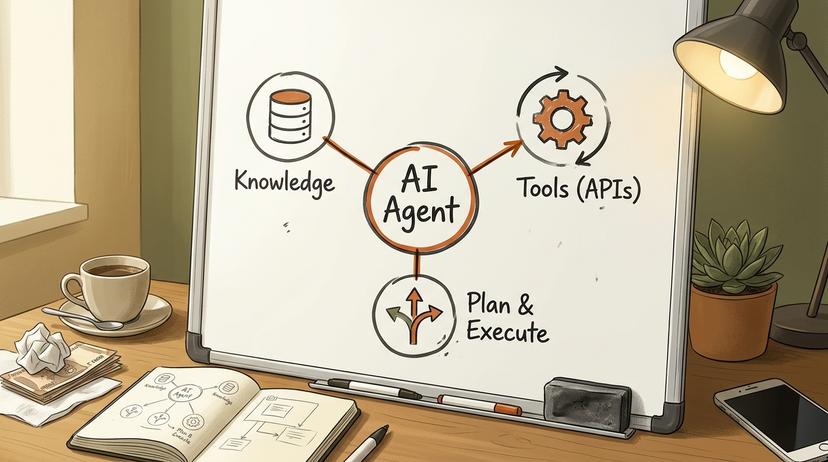
An AI agent is a system that can understand a goal, create a plan, and use tools to execute that plan autonomously. A chatbot answers questions; an AI agent performs multi-step tasks.
Think of it this way. You can ask a chatbot, “What’s the status of order #12345?” It will look it up and tell you. But you can tell an AI agent, “When a customer emails asking for a refund on a recent order, check if it was delivered in the last 14 days, confirm it wasn't a final sale item, process the refund in Stripe, and then email the customer a confirmation.”
The agent connects to your inbox, your e-commerce platform, and your payment processor to complete the entire workflow. It’s a subtle but massive difference. It's the difference between having a junior assistant who can only look things up and one who can actually run a process for you. For a deeper dive on this, we wrote about the real difference between a chatbot and an AI agent.
What Does an AI Agent Development Company Actually Do?
An ai agent development company designs, builds, and deploys these autonomous systems to handle specific business workflows. Their work isn't just about picking an AI model; it's about deeply understanding a process and then connecting the AI to the tools your team already uses.
A good product studio or tech partner will focus on a few key things:
- Process Mapping: Before a single line of code is written, they map out your existing manual workflow step-by-step. Where does the work start? What decisions are made? What tools are involved? This is honestly 80% of the job.
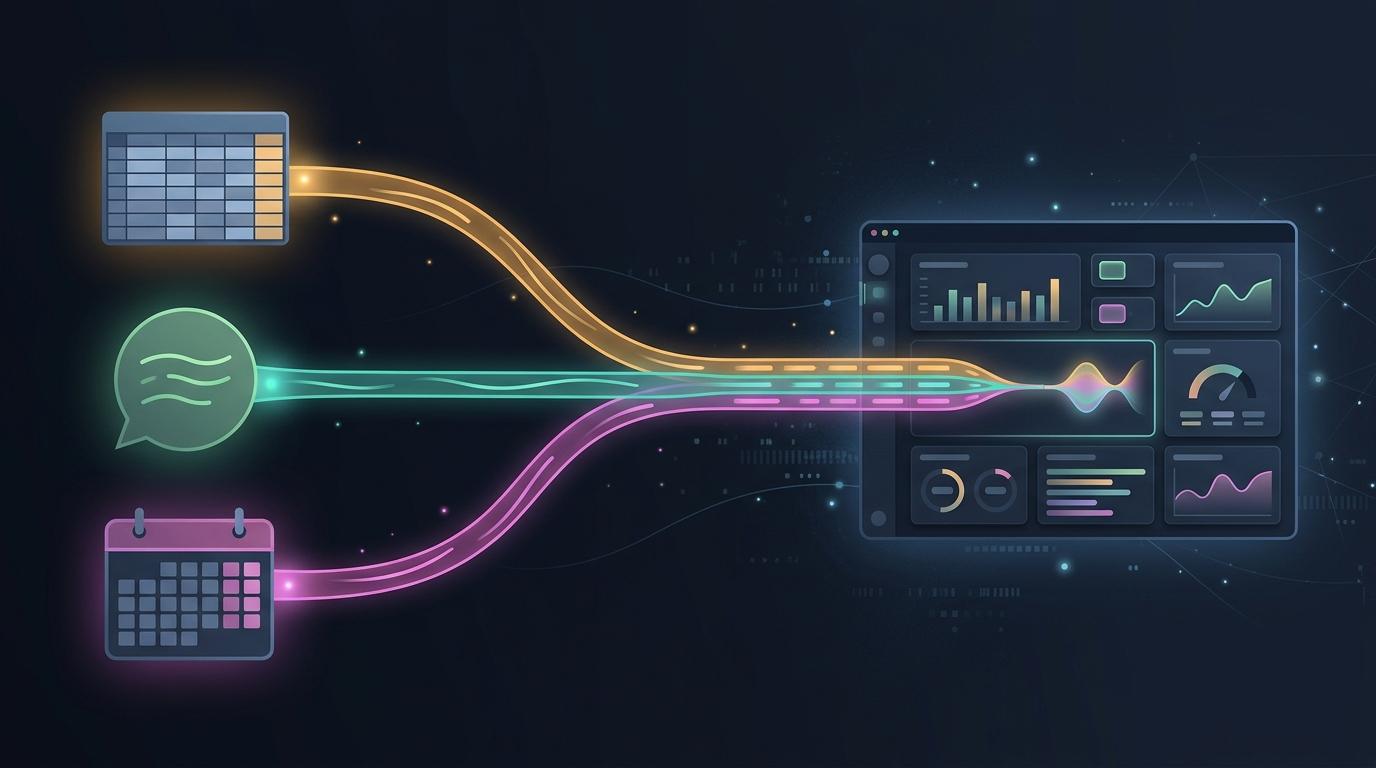
- Tool Integration: The goal is to connect your existing tools, not replace them. An agent might need to read a Google Sheet, create a task in Asana, send a message in Slack, and pull data from your internal dashboard. The real work is in making these connections reliable.
- Building Guardrails: What happens when the agent gets stuck or isn't sure? A huge part of development is creating rules and human-in-the-loop checkpoints. For high-stakes decisions, the agent might draft an email and wait for a human to click “approve.”
- Deployment & Maintenance: They handle the end-to-end process of getting the agent live and making sure it keeps running. As the underlying AI models or your own software APIs change, the agent needs to be updated.
They act as your outsourced product team, focused on solving a specific operational bottleneck.
How Much Does It Cost to Build a Custom AI Agent?
The cost to build an AI agent depends entirely on the complexity of the task and the number of integrations, not the novelty of the AI model itself. Based on industry data and our own experience building products like the Apexis Pro construction SaaS (a ₹4,00,000 project), costs generally fall into these buckets.
Here’s a realistic breakdown based on 2025-2026 data:
- Simple Prototype ($2,000 - $10,000): This gets you a basic agent that can perform a single, well-defined task using pre-trained models. Think of a smart FAQ bot that can pull answers from a private knowledge base. It’s great for proving a concept.
- Production-Ready Agent ($15,000 - $50,000): This is the most common range for startups and SMBs. This buys you a robust agent that integrates with multiple business systems (like your CRM, email, and project management tool) to execute a core workflow. A lead qualification agent that enriches new leads and assigns them to the right salesperson would fall in this range.
- Complex Multi-Agent System ($100,000+): This is enterprise territory. These are systems with multiple agents that collaborate, often requiring custom model fine-tuning and heavy security compliance.
Don't forget ongoing costs. Budget around 15-20% of the initial development cost annually for maintenance, monitoring, and API fees. As of late 2025, API costs for models like GPT-4o are around $5 per million tokens, but the real cost is in the infrastructure and developer time to keep the agent running smoothly.
How Long Does Building an AI Agent Take?
Building an agent is often faster than building a traditional web or mobile app, but a successful demo is not a deployed product. A realistic timeline for a production-ready agent is 6 to 12 weeks, with some more complex systems taking 3 to 5 months.
Here’s what that looks like in practice:
- Weeks 1-2: Scoping & Prototyping. We find that a working prototype on real data can often be built in about two weeks. This validates the core logic and integrations before committing to a full build.
- Weeks 3-8: Core Development & Integration. This is the bulk of the work. We build out the connections to your tools, refine the logic, and implement guardrails. At Rhinon Labs, we work in weekly releases, so you see progress constantly. A focused, single-task build can often be production-ready in this 2-4 week window.
- Weeks 9-12: Testing & Deployment. The agent is tested in a real-world environment, we build a human-in-the-loop dashboard for oversight, and then we deploy it.
The biggest variable isn't the code; it's the clarity of the process you're trying to automate. A well-defined workflow gets automated in weeks. A vague goal can take months and still fail.
When Should You Hire a Company vs. Building In-House?
You should hire an outside tech partner when speed and de-risking are more important than building an in-house competency from scratch. Conversely, you should build in-house if the agent is core to your company's long-term intellectual property and you have an engineering team with available capacity.
Let’s be direct. Ask yourself these questions:
Hire an external studio if:
- Your engineering team is already at full capacity building your core product.
- You need a solution live in weeks, not quarters.
- You want to avoid the cost and risk of hiring a specialized full-time AI/ML engineer.
- You want an end-to-end solution that includes deployment and maintenance, so your team doesn't have to worry about it.
- You want to ensure you get full ownership of the code and infrastructure, which a professional studio will always provide.
Build it in-house if:
- You have experienced engineers on your team who are excited to learn frameworks like LangChain or CrewAI.
- The process you're automating is a unique, proprietary advantage that you need to own completely from day one.
- You have the budget and time for R&D, including the inevitable dead ends.
Most startups and SMBs we talk to fall into the first category. Their main goal is to scale operations without adding headcount, and a tech partner is the fastest way to achieve that.
What Are the Most Common (and Painful) Mistakes?
Building AI agents feels new, but the failure patterns are classic product development mistakes. From our experience in the trenches, here are the ones that kill projects most often.
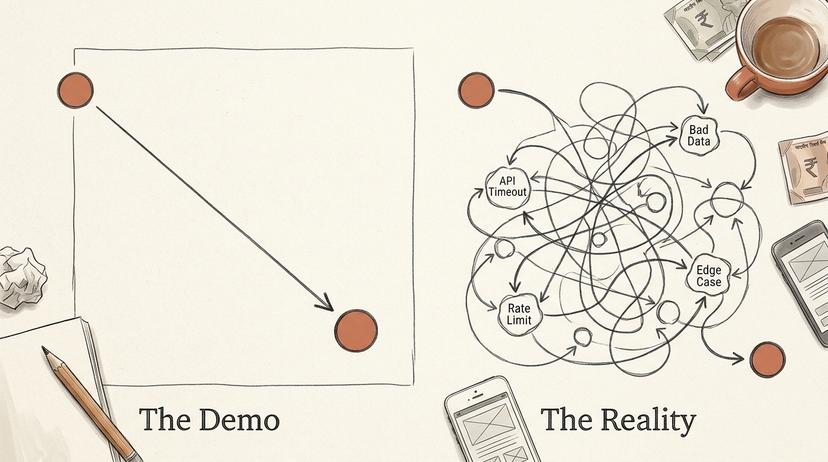
Mistake 1: Treating a Demo Like a Deployed Product
This is the big one. An agent that works perfectly in a controlled demo will almost certainly break in production. One study estimated that 88% of agents that work in demos fail when deployed to real workflows. The real world is messy: APIs have rate limits, data is formatted inconsistently, and people don't write emails the way you expect. A production-ready agent is 10% AI logic and 90% error handling and guardrails.
Mistake 2: Scoping Too Broadly
A project scoped as “Automate lead qualification” will fail. A project scoped as “When a new lead fills out the Typeform on our site, use the email to find their LinkedIn profile, check if their company has more than 50 employees, and if so, create a new contact in HubSpot and assign it to the 'Enterprise' sales queue” will succeed. Be ruthlessly specific.
Mistake 3: Underestimating the 'Last Mile' Problem
The AI model is rarely the bottleneck. The hardest part is always the “last mile”: integrating with legacy systems, dealing with authentication and permissions, and navigating security reviews. A 2025 Veracode study found that 45% of AI-generated code failed security checks. Getting this right is what separates a toy from a business tool. We wrote a bit about this in our guide to AI agent security for Indian SMBs.
Mistake 4: Not Planning for a Human in the Loop
For any process that involves money, customer relationships, or critical data, you need a human checkpoint. The best agent systems don't run completely dark. They run the process, flag anything unusual, and present a summary for a human to approve with a single click. This builds trust and prevents costly errors.
Ready to Automate a Real Workflow?
AI agents aren't magic. They are focused tools for executing well-defined, repetitive processes. The first step isn't to hire a developer; it's to map out one manual workflow that is slowing your team down today.
If you've identified a process that feels like a perfect candidate, we can help. At Rhinon Labs, we partner with startups and SMBs to build, deploy, and maintain the custom AI agents and internal dashboards they need to scale. It’s an end-to-end service.
Interested in seeing what's possible? Let's schedule a consultation to discuss your workflow.
Frequently asked questions
A chatbot is designed for conversation; it answers questions based on the information it has. An AI agent is designed for action; it uses tools (like your CRM, email, or internal APIs) to autonomously complete multi-step tasks to achieve a specific goal.
If your process follows a strict 'if this, then that' logic, simpler tools like Zapier might be enough. You need an AI agent when the process requires decision-making based on unstructured data (like the intent of an email) or involves a complex sequence of actions across multiple systems.
You should always have 100% ownership of the final code, designs, and infrastructure accounts. With any reputable product studio or tech partner, this is standard practice. If a company insists on retaining ownership, it's a major red flag.
Security is handled at the infrastructure and integration level. This involves using secure authentication (like OAuth) for all API connections, running the agent in a private cloud environment, and ensuring data is encrypted in transit and at rest. The agent should only have the minimum permissions required to do its job.
It typically starts with a discovery phase to map your manual workflow. This is followed by building a small prototype to prove the concept. Next is the main development phase with regular check-ins, and finally, deployment, monitoring, and ongoing maintenance.
Get an honest MVP assessment in 5 minutes.
We tell you what to build, what to skip, and what it'll actually cost. No fluff.
Assess My IdeaFree · 5 minutes · No obligation